Why it exists
Reading unfamiliar source code is hard when you do not yet know the main abstractions or how they fit together. A useful explanation needs an order, not just a wall of generated text.
Portfolio / CASE STUDY
Public prototype
Turns a GitHub codebase into chapter-based tutorials, relationship diagrams, and approachable explanations.
Repository analysis and learning experience
Reading unfamiliar source code is hard when you do not yet know the main abstractions or how they fit together. A useful explanation needs an order, not just a wall of generated text.
The application crawls a repository, filters files, identifies abstractions, analyzes their relationships, orders chapters, and generates Markdown explanations and Mermaid diagrams. An interactive file browser lets readers inspect the code alongside the generated material.
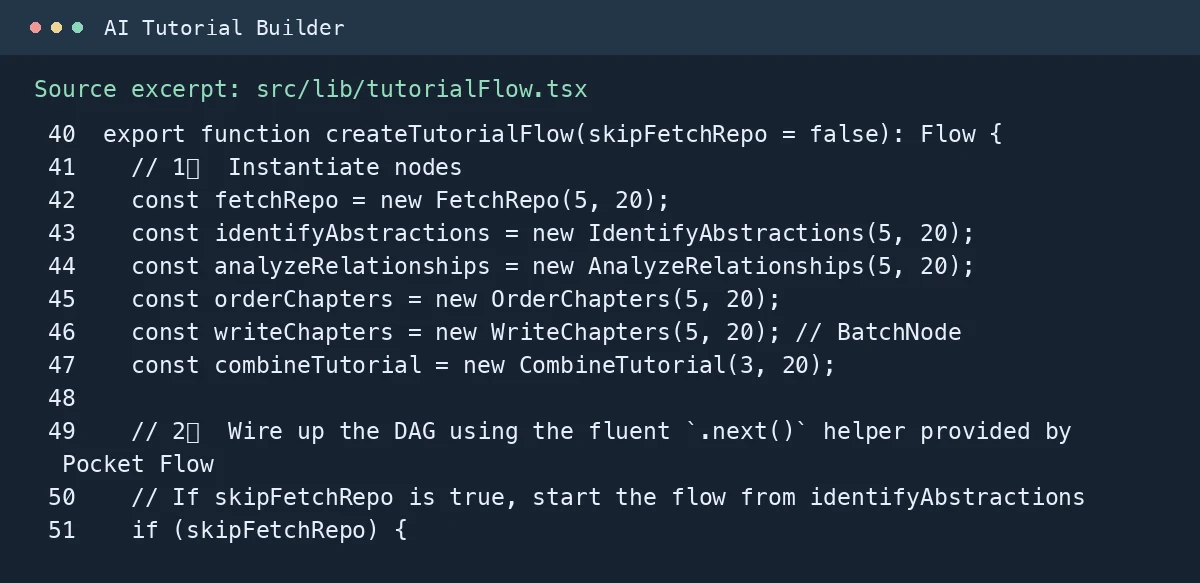
PocketFlow divides the process into explicit stages: fetching, identifying concepts, mapping relationships, ordering, writing, and combining. That makes the explanation workflow easier to reason about.
LLM response caching and cache statistics support reuse of identical requests. File include/exclude patterns limit what the model needs to analyze.
The README documents beginner-focused explanations, multilingual output, code walkthroughs, and diagrams rather than treating documentation as a source-code dump.
Public prototype. Generated explanations can be wrong or incomplete and should be checked against source code. Model access and repository permissions are required for the relevant operations. Related experiments include a portable Python CLI and adaptations to the upstream PocketFlow tutorial generator.